Reviews
No customer reviews for the moment.
PVC badge with Velcro
Dimensions: 10 cm diameter
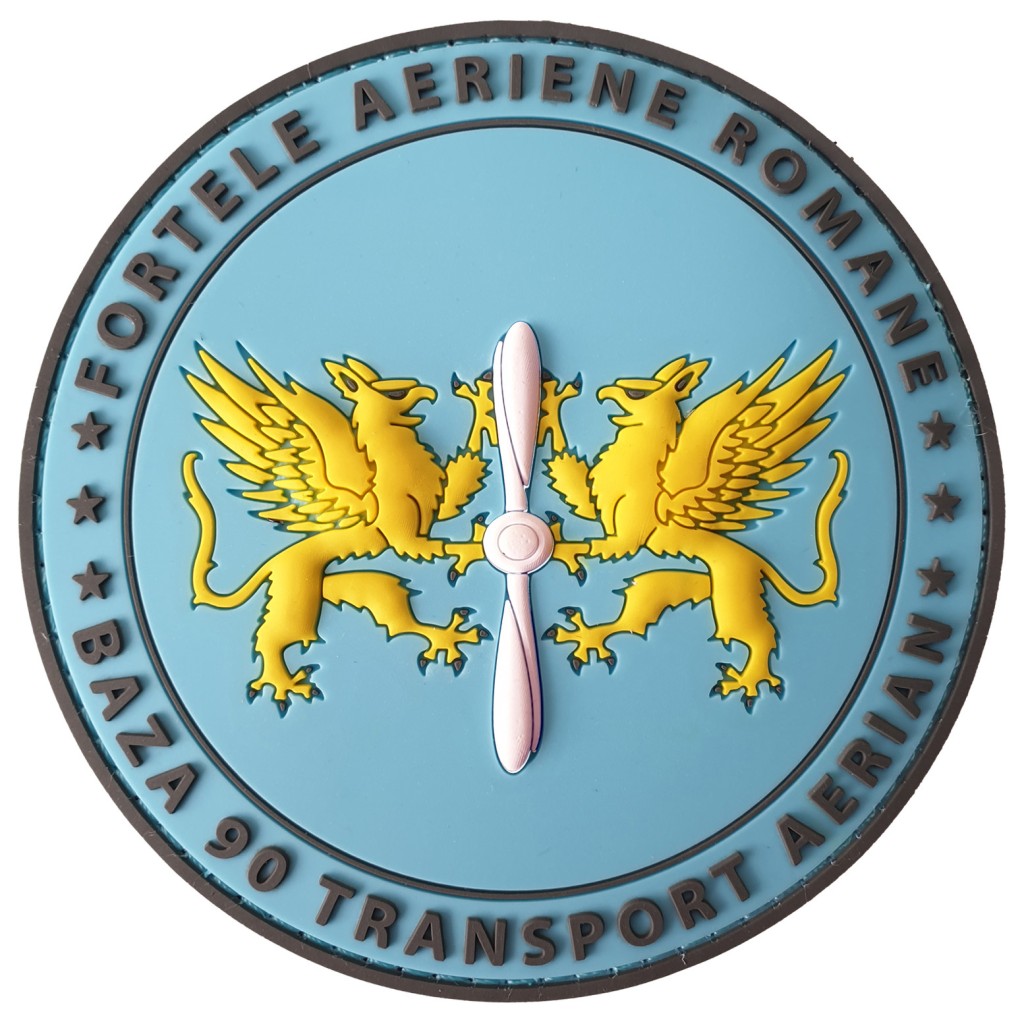
This emblem is inspired by the visual identity of the Romanian Air Force and the tradition of the 90th Air Transport Base unit, being made as a collector's patch close to the official version. The circular design features two golden griffins, traditional heraldic symbols associated with power, vigilance and protection, frequently found in military heraldry. Between them is a stylized propeller, which represents transport aviation and air missions dedicated to mobility and logistical support. The blue background suggests airspace and the tradition of military aviation.
The patch is made of durable PVC, with 3D relief and a diameter of 10 cm, being suitable for tactical equipment, jackets or collections dedicated to military aviation. It is an ideal piece for aviation enthusiasts, collectors or for those who want to wear a symbol inspired by the tradition of Romanian transport aviation.
HISTORY of Base 90 Air Transport
The name of Base 90 Air Transport "Gheorghe Bănciulescu" belongs to an aviator captain who was the first man in the world to fly with prosthetic lower limbs. He suffered a plane crash on September 12, 1926, during the Bucharest–Paris–Bucharest raid, hitting the Hirburm peak, near Raymarov, Czechoslovakia. After the accident, he continued flying and was decorated with the "Legion of Honor" by the President of the French Republic.
1941–1945. Establishment of Romanian military air transport
In August 1941, the first Romanian Military Air Transport Group was established, using aircraft and personnel from L.A.R.E.S. The units initially operated from Bucharest-Băneasa, with Junkers Ju 52 aircraft, organized into the 105th, 106th and later 107th Transport Squadrons. Missions included logistical transport, evacuations and air support in the context of World War II.
1945–1989. Reorganizations and consolidation
After the war, the Romanian military aviation went through major restructuring. The transport component was successively reorganized, depending on the doctrine and equipment of the period. Over time, Otopeni became the main center for transport aviation, concentrating logistical capabilities and special missions.
1990–1996. Opening to Western standards
After 1990, the profound modernization of transport aviation began. The emphasis shifted to interoperability and adaptation to NATO requirements.
In 1996, Romania received C-130 Hercules aircraft, a moment that marked the effective integration into the Western strategic transport system and the significant increase in operational autonomy.
2000–2010. NATO integration and external missions
After Romania joined NATO in 2004, Base 90 became the main provider of air transport for the external missions of the Romanian Army. Flights to the theaters of operations in Afghanistan, Iraq and the Western Balkans are constantly performed, as well as humanitarian missions.
Since 2010. Modernization of the tactical fleet
In 2010, the C-27J Spartan aircraft entered service, intended for tactical transport, medical evacuations and special missions. They gradually replaced the Antonov AN-24 and AN-26 aircraft. The C-27J Spartan is a twin-engine turboprop tactical transport aircraft, designed for logistics missions, airborne assault and medical evacuation. It has modern "glass cockpit" avionics, compatible with NATO standards, and can operate from short or poorly prepared runways.
Currently, the 90th Air Transport Base "Gheorghe Bănciulescu", deployed in Otopeni, represents the main air mobility element of the Romanian Air Force. Its operational structure is organized into three complementary squadrons. Squadron 901 provides strategic transport with C-130 Hercules aircraft, performing long-range missions, heavy transport and support for external operations. Squadron 902 operates C-27J Spartan aircraft, intended for tactical transport, regional missions, short runway operations and medical evacuations. Squadron 903 uses IAR 330 helicopters for light transport, tactical mobility, internal logistical support and punctual missions. Together, these structures provide the full capacity for strategic, tactical and support air transport, both nationally and within external commitments.
No customer reviews for the moment.