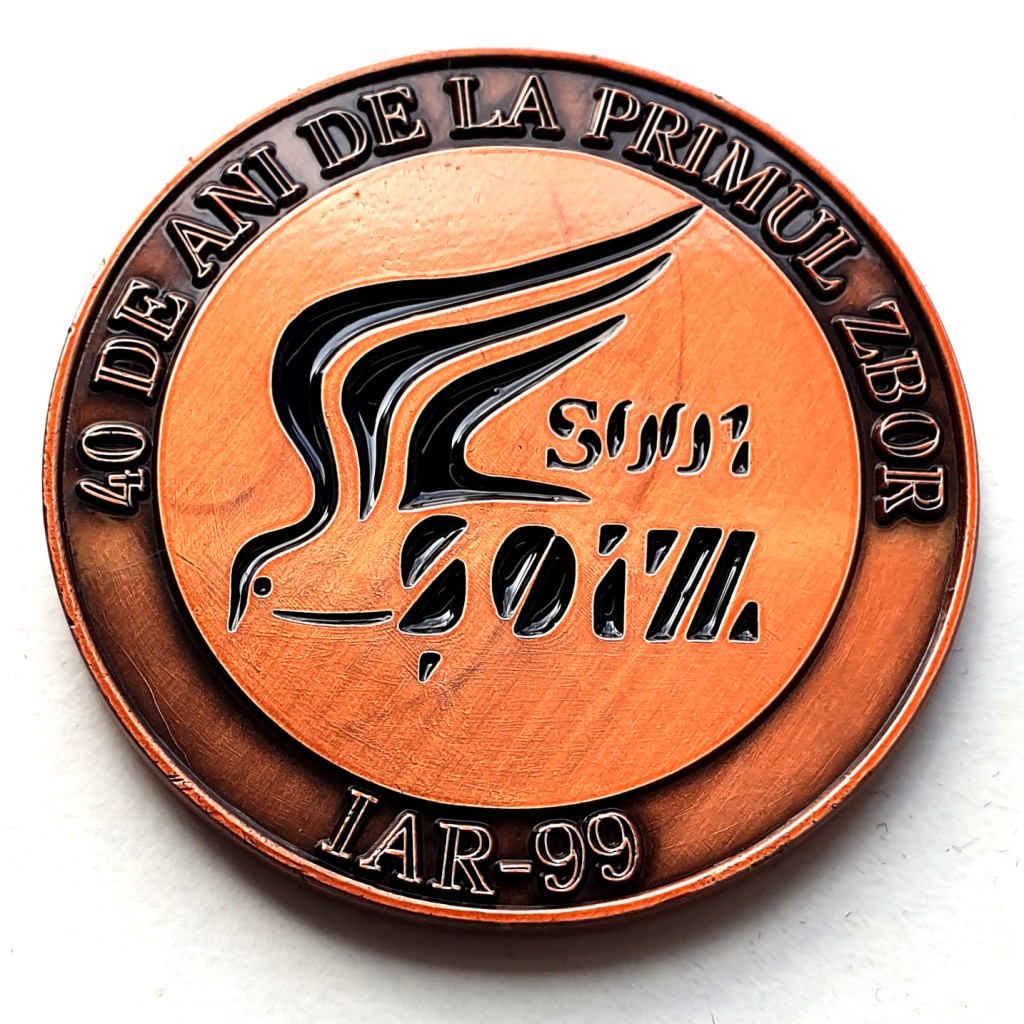
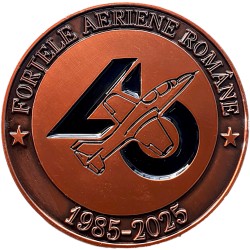
40 years since the first IAR-99 flight Annyversary Coin

40 years since the first IAR-99 flight Annyversary Coin

Hurry! only 45 items left in stock.
50.00 Lei
Tax included
Lowest price of the product in the last 30 days: 50.00 Lei
Quantity

In stock
 

Product Warranty and After-Sales Services Policy


Delivery, Shipping and Showroom Collection


Returns Policy and Right of Withdrawal

40th Anniversary Coin from the First Flight of the IAR-99 - 4.5 cm diameter

This commemorative coin is dedicated to the 40th anniversary of the first flight of the IAR-99 aircraft, one of the most representative projects of Romanian aviation.

The first flight of the prototype took place in December 1985, in Craiova, marking an important moment for the national aeronautical industry. The aircraft was designed to fulfill the role of a school and advanced training aircraft, intended to train military pilots before moving on to combat aircraft.
The S001 prototype, named "ȘOIM", took off for the first time from the runway of the Craiova airfield on December 21, 1985, the inaugural flight being carried out by Lieutenant Colonel test pilot Vagner Ștefănel and lasting approximately 21 minutes.

The IAR-99 program was developed by Romanian specialists in collaboration with the national aeronautical industry, the aircraft being produced at Avioane Craiova and involving numerous companies and research institutes in the field. After completing the tests and certification, the aircraft entered the Romanian Air Force, becoming an essential platform for training generations of military pilots.

The design of this coin marks both the historical moment of the first flight of the IAR-99, as well as the tradition and continuity of the Romanian Air Force, being an object dedicated to aviation enthusiasts and collectors of pieces with historical and aeronautical value.

Hurry! only 45 items left in stock.

In the 1970s, when Romanian flight schools were still using the L-29 Delfin and the L-39 Albatros, a team of engineers from INCREST (today, INCAS) began working on the design of a domestically designed aircraft, modern and adapted to the real needs of the Romanian Military Aviation. For four decades, the IAR-99 has been a constant presence in the skies of Romania. From the first flight of the prototype in 1985, through its presentation at the Le Bourget Air Show in 1999, to the flight testing of the SM (Modernized Standard) variant in 2023, the Romanian advanced jet trainer has crossed eras, doctrines and generations of pilots. In a world of increasingly sophisticated technologies, the IAR-99 remains proof that a platform designed in the country, by Romanian specialists, can fulfill its mission efficiently.

The IAR-99, the first jet trainer and school aircraft designed and built entirely in Romania, was designed to replace the Czech L-29 Delfin and L-39 ZA Albatros aircraft. The prototype S-001 took off for the first time on December 21, 1985, with Lieutenant Colonel Ștefănel Vagner at the helm. Created by researchers at INCREST (now INCAS), the aircraft has a semi-hull fuselage and two tandem cockpits equipped with ejection seats (originally British-made, currently domestically produced). Power is provided by a Rolls-Royce Viper turbojet (version 632-41, produced under license by Turbomecanica), generating a thrust of approximately 1,814 kgf. With a trapezoidal wing design and retractable tricycle landing gear, the aircraft is subsonic (maximum speed ~865 km/h) and has a ceiling of about 12,900 m. The IAR-99 entered series production in 1987, and by the end of the communist era, 28 aircraft (registered S-001, S-002, S-003/7003 and 701–725) had left the Craiova Aircraft Factory, most of them assigned to the Boboc flight school and gradually replacing the L-29 and L-39 ZA aircraft in its equipment. The aircraft demonstrated remarkable reliability, becoming a reliable partner in the training of generations of pilots.

Configuration and technical capabilities of the IAR-99 aircraft

From a constructive point of view, the IAR-99 has a semi-hull fuselage and low trapezoidal wing, two tandem cabins and Aerofina SC.HV-00 (originally Martin-Baker MK.RU-10J/LB) ejection seats, with the possibility of rescuing the pilot from H = 0 and V = 0. The Viper 632-41 engines provide the necessary traction for the flight regimes in the envelope, and the aircraft carries fuel in internal tanks, as well as in additional tanks attached under the half-planes (maximum autonomy ~ 1,100 km, without additional tanks). The platform has five attachment points (one central, located ventrally, and two under each half-plane), on which a payload weighing approximately 1,400 kg can be attached (PRND blocks, bombs of various calibers, specialized containers, etc.). Although it does not have fixed artillery armament, a container with a Griazev-Şipunov GŞ-23L cannon (caliber 23 mm and with a fire unit of 200 rounds) can be mounted under the aircraft's fuselage. However, technical data reveal modest performance compared to newer generation aircraft: maximum speed is only Mach 0.76, ceiling ~12,900 m, and climb speed reaches about 35 m/s. In general, at the time the IAR-99 was designed, these performances were considered adequate for the role of a training aircraft, advanced reactive training and ground attack, but are considered limited in relation to new NATO standards.

Successive Modernizations: Falcon and SM

With the changes of the 1990s, a program to update the avionics systems began for the IAR-99. In 1996 and 1997, in collaboration with the Israeli company ELBIT Systems, the ŞOIM standard (IAR-99 ŞOIM) was developed. During this phase, 13 aircraft (with registration numbers 709, 711–713 and 717–725) received modernized cabins, advanced training capabilities, and warning and protection systems against air-to-air and ground-to-air threats, of the IR and radar types. The cockpit was equipped with multifunction displays (MFD), and the DASH helmet was implemented in the aircraft architecture. The installation of this avionics system, a system compatible with that of the supersonic MiG-21 LanceR aircraft, allowed the integration of weapons of Western origin. The first IAR-99 ŞOIM flew in May 1997, and by the 2000s, 12 units (seven newly built and five modernized) had entered service. The modernized aircraft led to the establishment of a ŞOIM squadron, in order to train pilots for the transition to the MiG-21 LanceR fighter. With the entry into service of the IAR-99 ŞOIM aircraft, the Boboc Application School decided to operate the two IAR-99 variants in separate squadrons, with the non-modernized aircraft being called the IAR-99 Standard.

Starting in 2020, the Romanian aeronautical industry continued the modernization project under the name IAR-99 SM (Modernized Standard). A contract signed in May 2020 with the company Avioane Craiova provided for the modernization of 10 existing aircraft (of the Standard variant). According to this program, the first IAR-99 SM (registration number 715) was officially presented on December 22, 2023, with a paint scheme similar to the supersonic multirole F-16 aircraft (entered service with the Romanian Air Force in September 2016). The initial schedule provided for the delivery of one modernized specimen in 2022 and the entire batch of 10 by 2024, but the COVID-19 pandemic and disruptions in the supply chains significantly delayed the works. Thus, only in December 2023 did the flight testing of the first modernized aircraft begin, and in January 2025, the other nine were in various stages of repair and modernization. In the meantime, another agreement was signed in 2022, this time for the revitalization of a number of 10 IAR-99 ŞOIM aircraft. In total, of the 28 aircraft built, 21 were operational in the Romanian Air Force before the start of these renewal programs.

The modernization to the SM standard brings the aircraft state-of-the-art combat and training instruments. Thus, the cockpit is fully digitalized, equipped with HUD (Head Up Display) and multifunction displays (MFD) adapted to ensure familiarization with the avionics of the supersonic F-16 aircraft, HOTAS (Hands On Throttle-And-Stick) system and a virtual training system (EVAS) for simulating flight missions.

Modern GPS/INS systems and NATO-compatible IFF transponder have been installed, increasing interoperability with aircraft of allied forces. Additionally, the new electronic protection package includes a radar warning receiver (RWR), an electronic countermeasures module (ECM) and devices for launching thermal traps and anti-radar powder (chaff/flare). It is worth noting that the advanced trainer aircraft retains the Viper engine built under license by Turbomecanica, with the emphasis of the modernization being on digital avionics and platform revitalization, rather than interventions in the power plant area.

The technical programs involved domestic and international collaborations: Avioane Craiova leads the SM project, with support from ELBIT Systems (avionics and EVAS system), INCAS (design and integration), Turbomecanica (maintenance for Viper engines) and the Innovation Research and Flight Testing Center (testing). Romania’s investment in the modernization of the IAR-99 aircraft aims to extend the fleet’s lifespan by another 10–15 years and ensure that all Romanian pilots have access to training and preparation tools close to NATO standards

Operational parameters and technical-tactical relevance of the IAR-99 SM variant

Four decades after its first flight, the IAR-99 remains the main advanced reactive training aircraft of the Romanian Air Force. Recent upgrades make the IAR-99 SM a high-tech training platform: pilots become familiar with procedures and manage systems similar to those installed on the supersonic F-16, which was not possible with the standard version from the 1980s. In addition, with new avionics and weapons systems, this aircraft can effectively perform close air support or reconnaissance missions, being even capable of tactical air missions using modern weapons (bombs and guided missiles). However, inherent design limitations remain: the IAR-99 is and will remain a subsonic platform, with flight and maneuverability performance superior to jet aircraft from the 1960s, but inferior to modern transonic or supersonic training platforms (such as the Leonardo M-346, KAI T-50, etc.). For this reason, the IAR-99 SM does not compete with or aspire to lead to the complete replacement of next-generation aircraft, but mainly offers an economical and realistic transition to flying the F-16. In the Romanian Air Force's equipment scheme, the IAR-99 SM is seen as a cost-effective and affordable "lead-in fighter trainer", with largely national maintenance capabilities. Operational safety and technical lessons learned from the operation of the IAR-99

The operational history of the IAR-99 jet trainer was also marked by aviation accidents and catastrophes, which highlights the importance of strict maintenance and flight training procedures. The IAR-99 has multiple safety systems and rigorous testing protocols implemented today, but each serious flight event confirms the need for the existence of maintenance manuals and pilot training programs that are as solid and rigorous as possible. These lessons have been integrated into the culture of the Romanian Air Force units, so that rigor in checks, emergency simulations and continuous adaptation of safety equipment remain priority objectives. IAR-99 SM – modernization that keeps a Romanian aircraft relevant IAR-99 is an emblematic achievement of the Romanian aeronautical industry. Designed in Romania, manufactured in Craiova and successively equipped with newer technologies, the platform has evolved from a simple subsonic training aircraft to an aircraft with NATO-compatible avionics and armament. T

he SM modernization program reinforces this character, combining relatively low national operating and maintenance costs with the addition of modern instruments (HUD, MFD, EVAS, communications and NATO RWR). Even if the initial architecture of the IAR-99 aircraft imposes physical limits, the SM modernized version offers the student pilot the appropriate platform for training in conditions similar to a real combat situation. Through successive modernizations, the IAR-99 has demonstrated its adaptability: it does not replace the supersonic multirole F-16 or the new fighter jets, but it ensures the intermediate training of Romanian pilots and offers the possibility of air support, with 100% national logistics. Continuing the program, expanding domestic industrial support, and maintaining strict reliability and training standards are essential for the Romanian aircraft to continue flying safely and efficiently in the coming decades. The IAR-99 is more than just an aircraft: it is the expression of the rigor and creativity of an industry that refuses to give up. From the engineers at INCAS and Avioane Craiova, to the specialists at Turbomecanica and the pilots who flew it, the story of this aircraft is a lesson in perseverance, the Romanian “Falcon” thus remaining a bridge between yesterday’s technical tradition and tomorrow’s fifth-generation aviation – a wing that will not tire soon.

Text: Adrian Sultănoiu (article produced with the support of specialists from the Center for Research, Innovation and Flight Testing – CCIIZ) Photo: CCIIZ

Related Products

Reviews

No customer reviews for the moment.

Reviews can be placed by customers that purchased this product

20 other products in the same category: